

Cyber BCPCyber BCP Mawashitsuzukeru-kun
FDEs build it. AI keeps it running.
Cyber BCP Mawashitsuzukeru-kun automates how you plan, update, and run your BCP. In an incident, an AI agent gives instructions that follow procedures you approved in advance.
Our forward-deployed engineers (FDEs) work inside your sites and lead the rollout. After that, AI keeps it running.
- Launch:
- October 20, 2026
- For:
- Large enterprises, mainly in manufacturing
- Pricing:
- Quoted per engagement
01
The problem
Why factories fall behind
Factories work under three constraints.
They can't stop.Production can't be halted, so measures that need downtime are off the table.
They can't be touched.No one can freely touch control equipment while it runs.
No one is watching.No one on site looks after security.
As a result, factories remain the hardest place to improve security.

Three reasons plans haven't kept up
Companies have a BCP, but not one for cyberattacks.
Most BCPs plan for earthquakes and floods. They don't say which operations to restore first, when to shut systems down, or how to decide on disclosure as an attack unfolds.
Plans exist, but no one has turned them into actions.
A cyber BCP spans IT, business units, and crisis management. With no clear owner, the documents sit untouched, with no updates and no drills.
Plans stop short of the factory floor.
Most plans stay inside IT. They don't cover the recovery order or fallback procedures for control systems.
02
By the numbers
The current situation in numbers
123
Ransomware damage reports in the first half of 2026, the most ever for a half-year period.
Source: National Police Agency, "Cyber Threat Situation in the First Half of Reiwa 8," September 10, 2026.
37 in manufacturing
Manufacturing led all industries, followed by wholesale and retail (15), information and communications (9), real estate (9), healthcare and welfare (9), and construction (8).
Source: National Police Agency, "Cyber Threat Situation in the First Half of Reiwa 8," September 10, 2026.
Over 80% / under 30%
More than 80% of affected companies had backups. Fewer than 30% could restore from them.
Source: National Police Agency
75.8%
BCP adoption rate among large companies (fiscal Reiwa 7).
Source: Cabinet Office, "Survey on Business Continuity and Disaster Preparedness," March 2026
03
Service overview
Three modes, from planning to incident response
Cyber BCP Mawashitsuzukeru-kun runs in three modes.
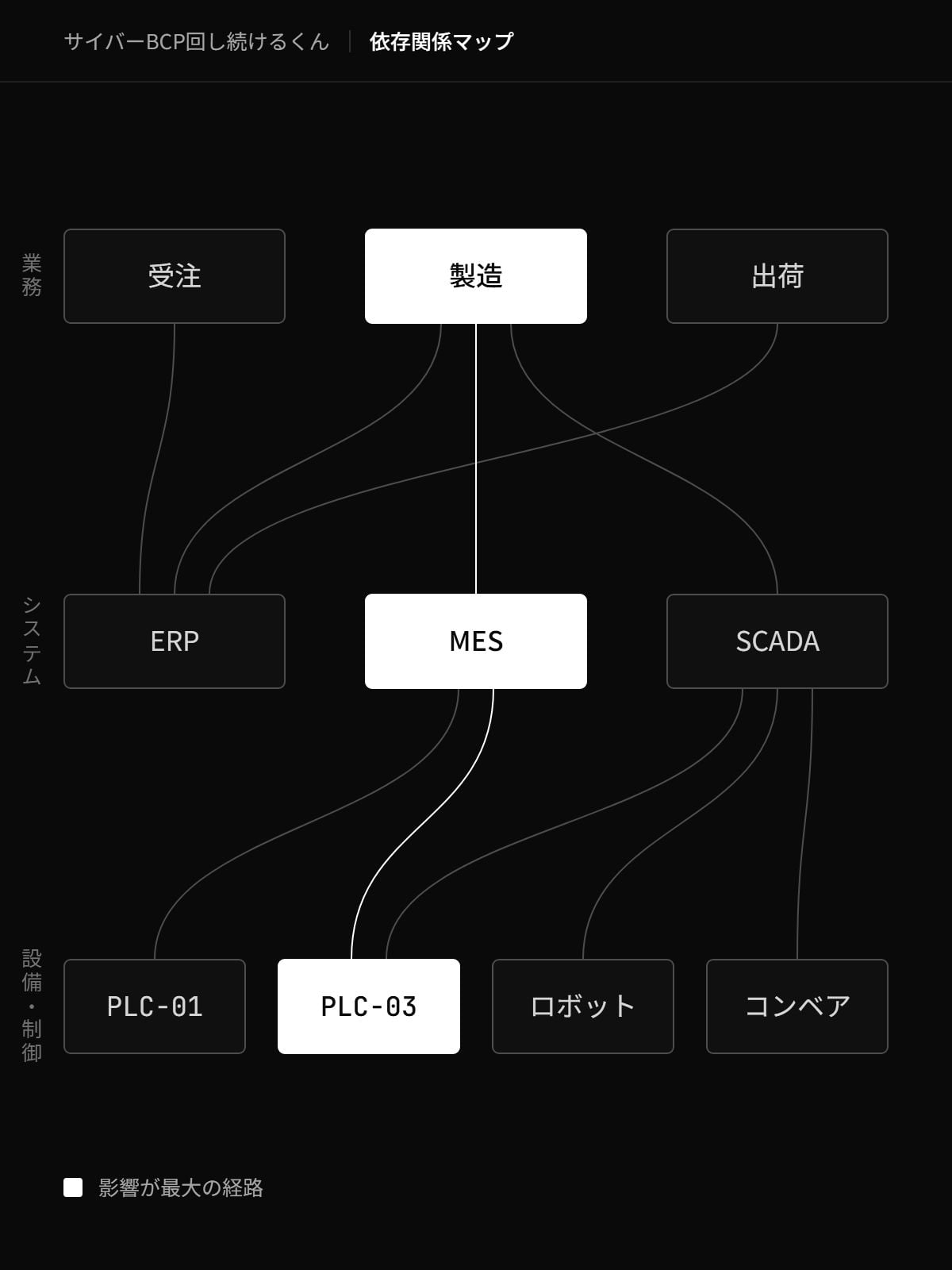
Planning (at rollout)Screens are for illustration. 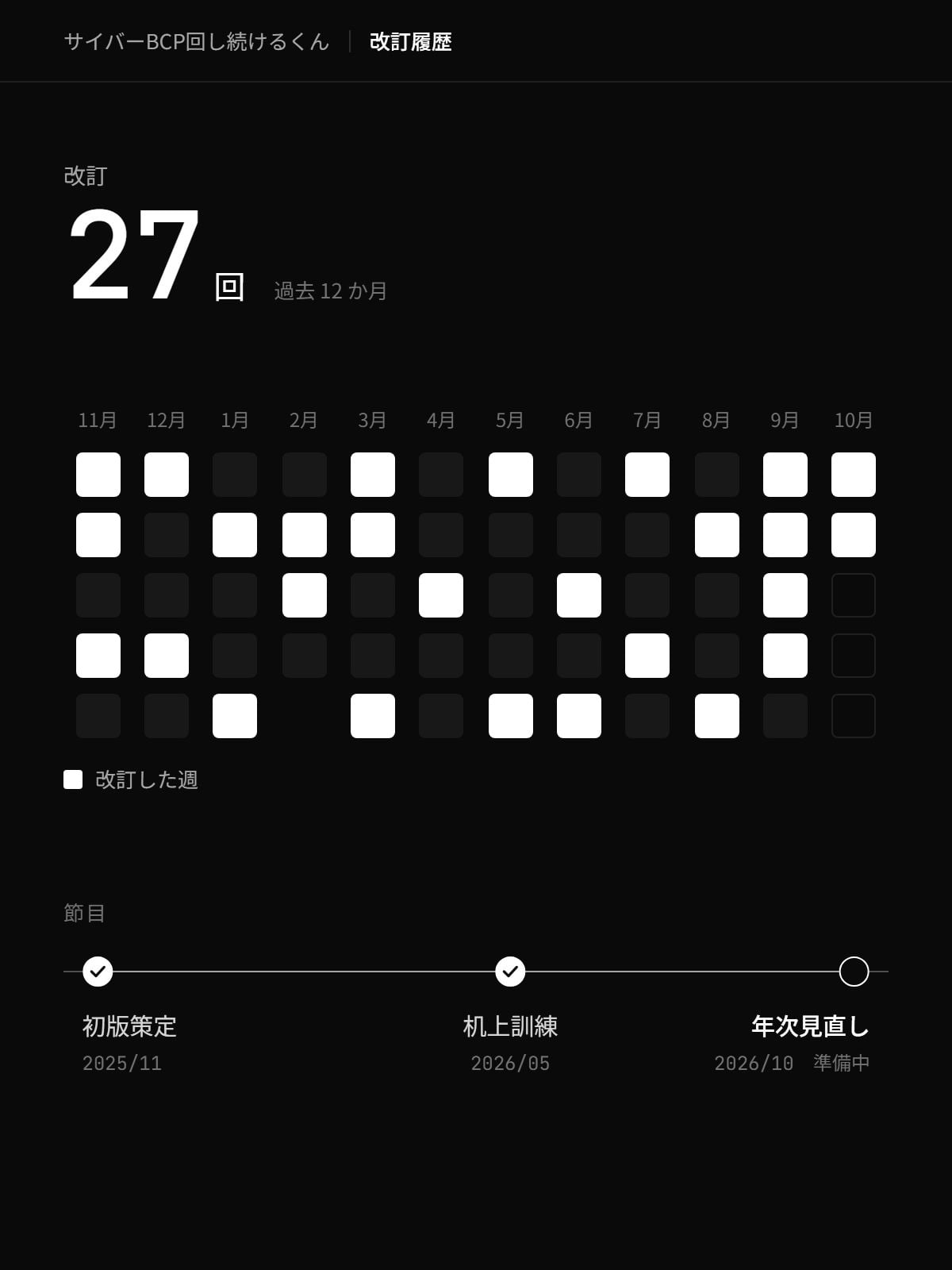
Updates and operation (normal times)Screens are for illustration. 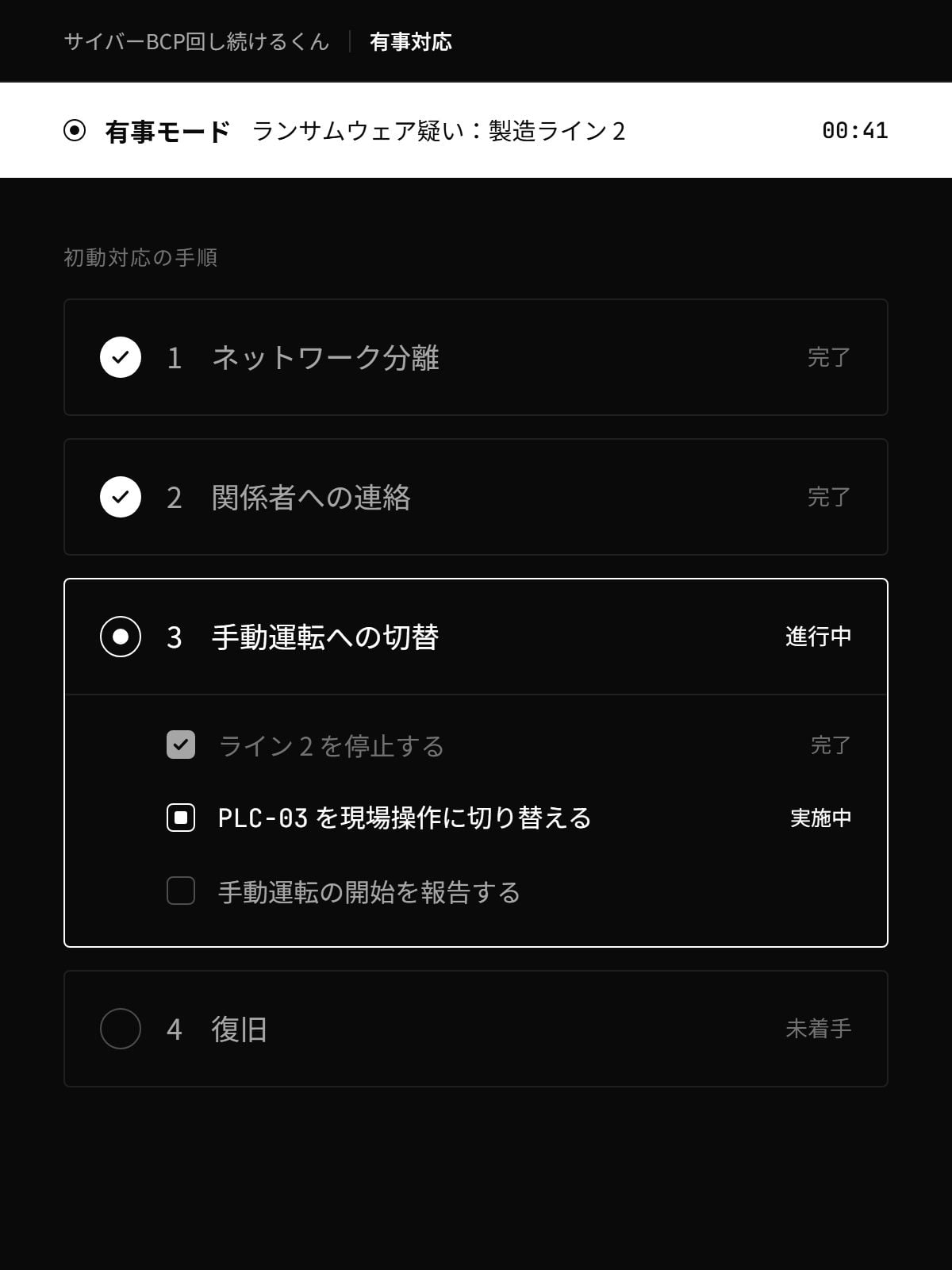
Incident responseScreens are for illustration.
| Mode | What AI does | What FDEs do | What you do |
|---|---|---|---|
| Planning (at rollout) | Reads your existing documents, generates the BCP, and lists the decisions you need to make. | Interview your teams on site and draw out management's decisions. | Make decisions and approve. |
| Updates and operation (normal times) | Detects changes inside and outside your company, revises the BCP, and plans and scores drills. | Run periodic reviews and drills. | Approve revisions and take part in drills. |
| Incident response | Starts on an alert or report and identifies the scenario. Gives instructions for initial containment, communication, and recovery that follow approved procedures. Tracks reporting deadlines and shows the required steps. | — | Carry out instructions, handle decisions the procedures don't cover, and decide whether and what to report. |
Planning (at rollout)
- What AI does
- Reads your existing documents, generates the BCP, and lists the decisions you need to make.
- What FDEs do
- Interview your teams on site and draw out management's decisions.
- What you do
- Make decisions and approve.
Updates and operation (normal times)
- What AI does
- Detects changes inside and outside your company, revises the BCP, and plans and scores drills.
- What FDEs do
- Run periodic reviews and drills.
- What you do
- Approve revisions and take part in drills.
Incident response
- What AI does
- Starts on an alert or report and identifies the scenario. Gives instructions for initial containment, communication, and recovery that follow approved procedures. Tracks reporting deadlines and shows the required steps.
- What FDEs do
- —
- What you do
- Carry out instructions, handle decisions the procedures don't cover, and decide whether and what to report.
Incident response mode is available within the scope above. AI makes no new decisions. People decide whether and what to report; AI only presents the information.
04
Workflow
Four phases
The work runs in four phases: rollout, requirements, normal times, and incidents. FDEs lead the first two. AI runs normal times. In an incident, AI gives instructions that follow approved procedures. Lessons from each incident go back into the BCP.
Rollout (led by FDEs)
We work on site and build your cyber BCP.
Requirements (led by FDEs)
Around that BCP, we define an AI agent for your company. We build it to fit your organization, systems, control-system scope, and supplier network.
Normal times (run by AI)
AI detects changes and revises the BCP. It runs drills and restore tests and reports to management on a regular schedule. People approve the revisions.
Incidents (AI gives instructions)
AI starts on an alert or report and gives instructions that follow approved procedures. People carry them out and make any call the procedures don't cover.
People decide just two things: what to approve in advance, and anything the procedures don't cover.
05
Onboarding
How onboarding works
FDEs lead the rollout. The first version of your cyber BCP typically takes three to six months. Pricing is quoted per engagement.
DiagnoseYou answer a questionnaire, and we identify what your BCP is missing.
Review the current stateFDEs read your BCP, policies, and system diagrams, interview your teams, visit your sites, and map how each operation depends on systems.
Make the key decisionsWe lay out the issues and options, such as cut-off authority, ransom policy, and restart criteria. Management decides. FDEs facilitate.
Generate the BCPFrom those decisions, we automatically generate the BCP and a decision card, a one-page sheet to read in an incident. FDEs review it, and you approve it.
Test with drillsWe design drill scenarios and measure the results. You take part, and FDEs run the drills.
After onboarding, the plan moves into normal-time operation.
06
Features
Three features

We plan down to the factory floor (OT).
OT/ICS security is our core business, so we build your BCP to include control systems. An attack may come in through IT, but it's the factory that stops.
It doesn't end once it's written.
In normal times, AI detects internal and external changes and revises the BCP.
In an incident, AI starts on an alert or report and identifies the scenario. Its instructions for containment, communication, and recovery follow procedures approved in advance.
You don't need a dedicated specialist in-house.
After rollout, AI runs the plan, so you can keep your cyber BCP current without a dedicated specialist.
You still need someone in-house to approve revisions and reports.
07
Safety by design
Five conditions for AI to give instructions in an incident
We believe AI can give instructions in an incident only when five conditions hold. We design around all five.
Instructions follow approved procedures only.AI's job is to carry out the decision card (cut-off conditions, who has authority, reporting deadlines) quickly. It makes no new decisions. Anything outside the procedures, such as paying a ransom or shutting down the whole company, goes to the person in charge.
It runs outside your IT environment.If it sat alongside your internal network and identity systems, an attack would take it down too. It stays available from a smartphone even if every internal system is down.
AI instructions can't be spoofed.We assume attackers will pose as the AI and send fake instructions. Instructions arrive only through pre-registered channels, and recipients can verify that they're genuine.
If AI goes down, the same procedure still works.When AI is unavailable, teams run the same procedure from a paper decision card.
Every instruction and action is logged with a timestamp.The log goes straight into reports, evidence, and post-incident BCP revisions.
08
How we differ
How this differs from other approaches
There are other ways to build a cyber BCP. Here is how each approach compares with ours.
| Other approach | How it works | This service |
|---|---|---|
| Add a chapter to a disaster BCP | A cyberattack chapter is added to a BCP written for earthquakes and floods. | We rebuild it, control systems included.We rebuild the BCP around how an attack unfolds, including control systems. |
| Planning support only | Support ends once the plan is written. Updates and operation are out of scope. | After planning, AI keeps it running.After planning, AI keeps running revisions, drills, and reports. In an incident, it gives instructions that follow approved procedures. |
| All-hazards drafts by AI | AI drafts a BCP for disasters in general. | We focus on cyberattacks.We focus on cyberattacks, include control systems, and keep the plan running after it's written. |
- This service
- We rebuild it, control systems included.We rebuild the BCP around how an attack unfolds, including control systems.
- Other approach
- Add a chapter to a disaster BCP
- How it works
- A cyberattack chapter is added to a BCP written for earthquakes and floods.
- This service
- After planning, AI keeps it running.After planning, AI keeps running revisions, drills, and reports. In an incident, it gives instructions that follow approved procedures.
- Other approach
- Planning support only
- How it works
- Support ends once the plan is written. Updates and operation are out of scope.
- This service
- We focus on cyberattacks.We focus on cyberattacks, include control systems, and keep the plan running after it's written.
- Other approach
- All-hazards drafts by AI
- How it works
- AI drafts a BCP for disasters in general.
09
Track record and company
Track record and company
- Selected for the accelerator program of GTIE, a startup support platform for university spinouts.
- Delivered cybersecurity training to 18 companies.
- Before the company was founded, our founding members supported security projects for government agencies and major telecom carriers. Winner of the Minister of Education, Culture, Sports, Science and Technology Award at the 21st Information Crisis Management Contest (May 2026).
Contact
Start with a 15-minute consultation
Tell us about your situation, and we'll outline how we would proceed. Pricing is quoted per engagement.
Book a 15-minute consultation